
The Hong Kong leak demands an F-35 redesign
A leak linked to F-35 parts seized in Hong Kong is driving demands to redesign the aircraft, highlighting security concerns around technology in a program that has undergone successive capability upgrades.
AI-assisted synthesis · Based on 4 independent reports from 5 outlets · Article text read from 1 of 4 reportsHow it's made
View timeline · 6 entries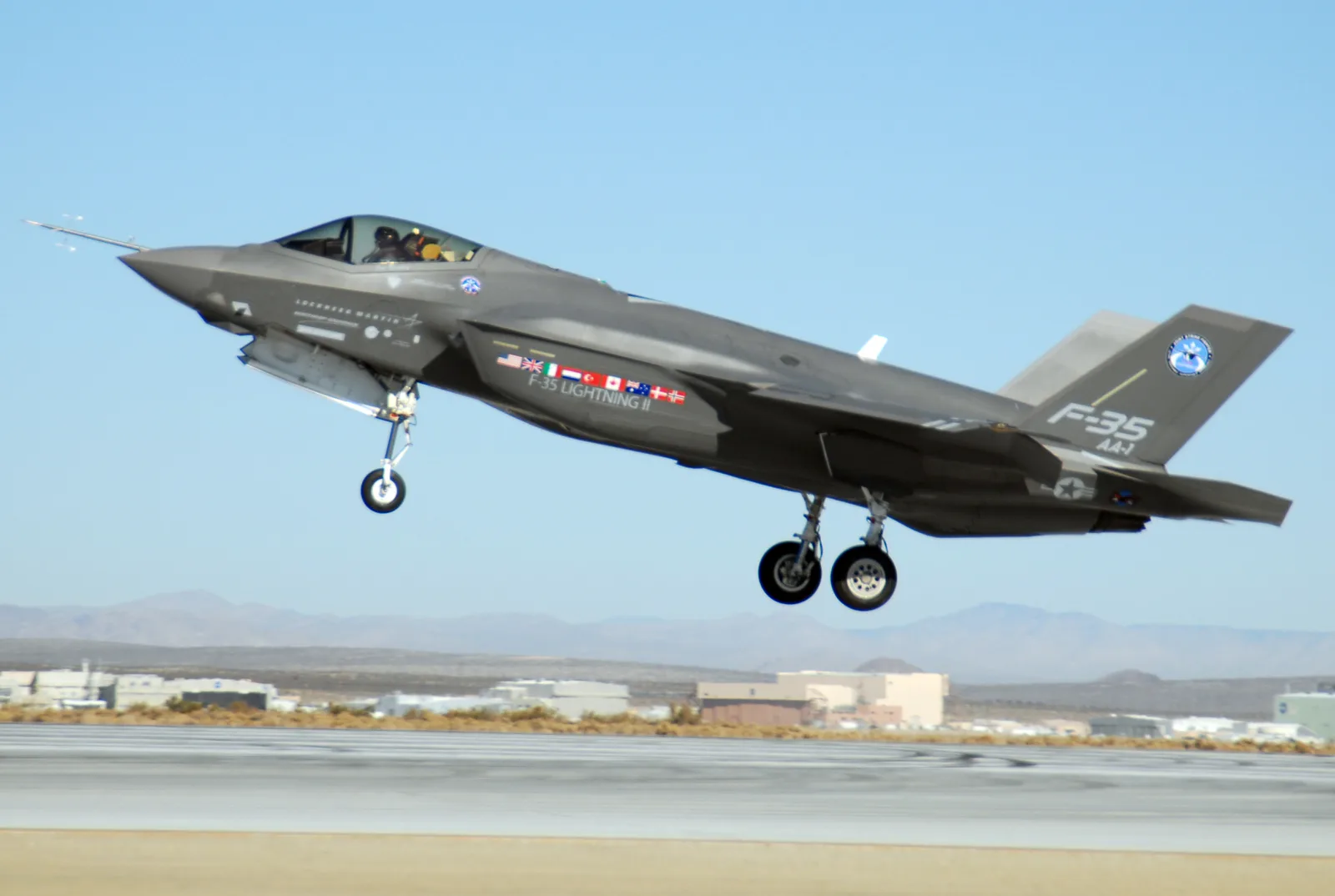 File photo
What happened
The brief
Lockheed Martin received a $114.63 million U.S. Navy order to redesign two navigation subsystems used by the F-35 Lightning II. The Defense Watch reported that the work addresses obsolete electronic components that could otherwise disrupt aircraft production and long-term support.
Military Aerospace’s headline also reported the $114.6 million redesign order, without providing additional details in the headline. The order covers the Global Positioning System Electronic Unit and the NAV100 Inertial Navigation System. The Defense Watch described the work as a component-level redesign, encompassing engineering, integration, qualification and testing.
It said the contract does not confirm a new navigation capability or a wider upgrade to the aircraft’s avionics suite. Naval Air Systems Command is managing the award from Patuxent River, Maryland. The contract announcement, as described by The Defense Watch, schedules work to continue through January 2030. The outlet said the order supports F-35 requirements across the U.S.
Air Force, Navy and Marine Corps, along with international cooperative program partners. The stated contract total is $114,629,966. The Defense Watch reported that the funding is divided among three sources: $46,411,323 from fiscal 2026 Air Force aircraft procurement, $46,411,322 from fiscal 2026 Navy aircraft procurement and $21,807,321 from F-35 cooperative program partners.
The outlet said the full amount is scheduled to be obligated at the time of award. The description of the work limits its stated scope to replacing and qualifying the two navigation subsystems.
The Defense Watch did not characterize the order as adding a new navigation function; instead, it presented the effort as addressing obsolescence tied to production and long-term support.
The headline from Military Aerospace corroborates that Lockheed Martin received an order to redesign F-35 navigation electronics, but does not state a schedule, funding breakdown or technical scope. The work’s stated timeline runs through January 2030, while the contract announcement provides for full funding obligation at award.
Those are the clearest next steps specified in the account: completion of the contracted engineering and testing work, and the scheduled obligation of the award amount. The reported order does not identify a delivery date for redesigned components or describe a broader aircraft upgrade.
Why it matters
- The seizure of F-35 parts in Hong Kong exposes a vulnerability in the aircraft’s supply chain: components or technical information could reach actors seeking to study or compromise the jet. U.S. and allied air forces, along with defense contractors, may face tighter shipping and export controls and pressure to redesign or replace vulnerable systems, adding cost and potentially delaying upgrades.
What to watch next
- Over the next few weeks, watch for the U.S. Navy or Lockheed Martin to disclose which navigation components will be replaced and whether the redesign requires changes to fielded F-35s.
- Track follow-on Navy contract notices and test milestones for the two subsystems, including any schedule changes to the work planned through January 2030.
- Look for the Pentagon or F-35 Joint Program Office to assess whether the Hong Kong leak exposes exploitable details and to issue mitigation guidance to U.S. and allied operators.
- Watch for F-35 operators to announce inspections, software updates, or other fleet measures if officials identify a specific exploitation risk.
How it's being covered
Coverage analysisShow details5 source articles · 5 unique outlets · 4 distinct reportsOutlet political mix: Too few rated· 1 Center · 1 Right · 3 unratedWhere the outlets are based: Unknown 60% · US/Canada 40%
How outlets' accounts compare
Timeline
Developments from this story's sources, dated background we compiled and fact-checked, and our earlier coverage. Each row says which.- On October 26, 2001, the U.S. Department of Defense selected Lockheed Martin’s X-35 over Boeing’s X-32 to develop the aircraft.Background · from our historical context
- The first F-35A test aircraft flew on December 15, 2006.Background · from our historical context
- The U.S. Marine Corps declared the F-35B initially operational.Background · compiled and fact-checked by Updat3
- The U.S. Air Force declared the F-35A initially operational.Background · compiled and fact-checked by Updat3
- In 2018, the U.S. Department of Defense began the Block 4 modernization effort, intended to add weapons and other capabilities across the three F-35 variants.Background · from our historical context
- The U.S. Navy declared the F-35C initially operational.Background · compiled and fact-checked by Updat3
How we got here
The F-35’s navigation electronics sit within an aircraft program whose capabilities have been expanded through successive upgrades. In 2018, the U.S. Department of Defense began the Block 4 modernization effort, intended to add weapons and other capabilities across the three F-35 variants. The F-35 program grew out of the Joint Strike Fighter competition.
On October 26, 2001, the U.S. Department of Defense selected Lockheed Martin’s X-35 over Boeing’s X-32 to develop the aircraft. The first F-35A test aircraft flew on December 15, 2006. The F-35 was intended to function as a networked combat aircraft, not merely as a replacement airframe. The U.S.
Original sources
3 of 5 articles · Unknown · Show allEvery story links to the reporting it was built from. How we choose sources
Spotted a factual error, a broken link or a misleading summary? Tell us.