
El-Sayed left Detroit health post after 18 months to pursue governor's race
Abdul El-Sayed left Detroit’s health director post in 2017 after 18 months to run for governor, and later launched a U.S. Senate campaign. His brief government tenure drew criticism from Republican opponent Mike Rogers and former campaign staffer Jordan Domingue.
AI-assisted synthesis · Based on 5 outlets' reporting · Article text read from 1 of 5 outletsHow it's made
View timeline · 7 entries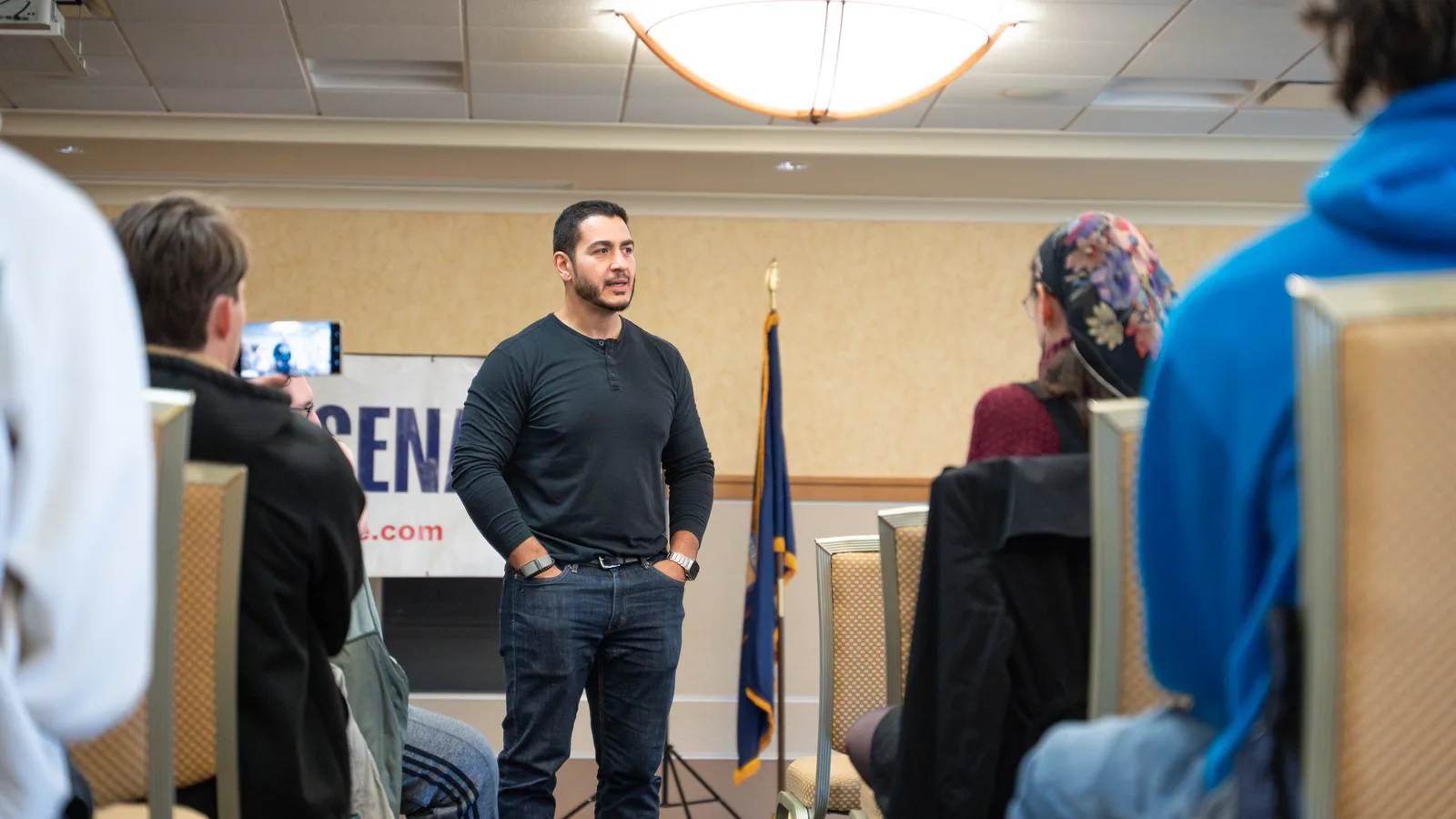 File photo
What happened
Key facts
- El-Sayed said he decided on January 3, 2017, that he should not continue in the Detroit health director role (per freebeacon.com).
- When El-Sayed interviewed for the Wayne County health director job in 2023, he said he had no intention of leaving soon for political office and intended to stay for the long haul (per freebeacon.com).
- El-Sayed later launched a U.S. Senate campaign and has promoted his record in two health director jobs (per freebeacon.com, rev.com, britannica.com).
- Republican opponent Mike Rogers said Michigan could become a lesser priority if El-Sayed pursued higher office (per freebeacon.com, rev.com).
- El-Sayed cited the judgment that the Detroit job was not what he should be doing at that time when explaining his departure (per freebeacon.com, deadlinedetroit.com, freep.com).
The brief
Abdul El-Sayed left his post as Detroit’s health director in 2017 after 18 months to run for governor, according to the Washington Free Beacon. He later launched a U.S. Senate campaign and has promoted his record in two health director jobs. His short tenure in Detroit is now part of scrutiny of his experience and his statements about public service.
The account says El-Sayed described his decision as a realization that the Detroit role was not what he should be doing at that point. He recalled reaching that judgment on January 3, 2017, as he prepared to return to work. The report provides his explanation for leaving but does not describe additional circumstances around the decision.
El-Sayed’s later comments about the Wayne County health director job provide a contrast. When he interviewed for that position in 2023, he said he had no intention of leaving soon to pursue political office and described himself as committed for the long haul. The Free Beacon reports that he subsequently entered a U.S.
Senate campaign; it does not provide a date for that launch. Republican opponent Mike Rogers questioned whether a Senate candidate focused on higher office would keep Michigan a priority. Rogers also said El-Sayed talked about building a movement and running for president in 2028. Those are Rogers’s criticisms, not an established account of El-Sayed’s future plans.
The Free Beacon also reports that Jordan Domingue, a former staffer on both El-Sayed campaigns, left the Senate campaign this year over El-Sayed’s anti-Israel views. Domingue characterized El-Sayed as thinking highly of himself. The article does not provide further detail on the departure or on Domingue’s specific reasons beyond that stated disagreement.
The report places the dispute over El-Sayed’s record alongside a broader argument about his political ambitions: his departure from Detroit preceded a run for governor, and he later sought a Senate seat. El-Sayed’s comments about his 2023 job interview, Rogers’s criticism and Domingue’s account present distinct perspectives on his public-service record and political focus.
Why it matters
- El-Sayed’s departure from Detroit’s health director post after 18 months is a concrete part of the experience he later promoted in seeking higher office.
- El-Sayed’s 2023 statement that he intended to stay in the Wayne County role for the long haul contrasts with his earlier departure to run for governor.
- Mike Rogers’s criticism focuses on whether Michigan would remain a priority if El-Sayed pursued higher office.
What to watch next
- Whether El-Sayed continues to promote his record in two health director jobs during his U.S. Senate campaign.
- Whether Mike Rogers continues to argue that El-Sayed’s pursuit of higher office could reduce Michigan’s priority.
- Whether El-Sayed or his campaign addresses Jordan Domingue’s stated reason for leaving the campaign.
How it's being covered
Coverage analysisShow details5 source articles · 5 unique outletsOutlet political mix: Mostly Center· 2 Center · 1 Right · 2 unratedWhere the outlets are based: US/Canada 60% · Unknown 40%
How outlets' accounts compare
Timeline
Developments from this story's sources, dated background we compiled and fact-checked, and our earlier coverage. Each row says which.- Abdul El-Sayed was born in Michigan to Egyptian immigrant parents.Background · compiled and fact-checked by Updat3
- In 2012, Detroit’s emergency manager closed the city department and transferred many public-health responsibilities to the Wayne County health department.Background · from our historical context
- The city reopened its health department in 2015 under Mayor Mike Duggan, creating a new municipal role for public-health leadership.Background · from our historical context
- Abdul El-Sayed lost the Democratic primary for Michigan governor to Gretchen Whitmer.Background · compiled and fact-checked by Updat3
- Abdul El-Sayed said he intended to stay for the long haul when he interviewed for Wayne County health director.Background · compiled and fact-checked by Updat3
- Mike Rogers lost Michigan's U.S. Senate election to Democrat Elissa Slotkin.Background · compiled and fact-checked by Updat3
- Abdul El-Sayed entered the Democratic primary for Michigan’s open U.S. Senate seat.Background · compiled and fact-checked by Updat3
How we got here
In 2012, Detroit’s emergency manager closed the city department and transferred many public-health responsibilities to the Wayne County health department. The city reopened its health department in 2015 under Mayor Mike Duggan, creating a new municipal role for public-health leadership.
Detroit’s fiscal crisis formed part of that backdrop: the city filed for Chapter 9 bankruptcy on July 18, 2013, and emerged from bankruptcy in December 2014. The department’s restoration also came amid heightened attention to Michigan’s public-health systems.
Original sources
2 of 5 articles · Unknown · Show allEvery story links to the reporting it was built from. How we choose sources
Spotted a factual error, a broken link or a misleading summary? Tell us.