
Johnson urges Republicans to disregard polls as he campaigns for House seats
House Speaker Mike Johnson said Republicans would disregard polls, arguing that low GOP participation in polling makes the surveys unreliable. He said he plans to campaign in 40 districts across 22 states and identified 22 races as decisive for control of the House.
AI-assisted synthesis · Based on 4 independent reports from 5 outlets · Full text read from 2 of 4 reportsHow it's made
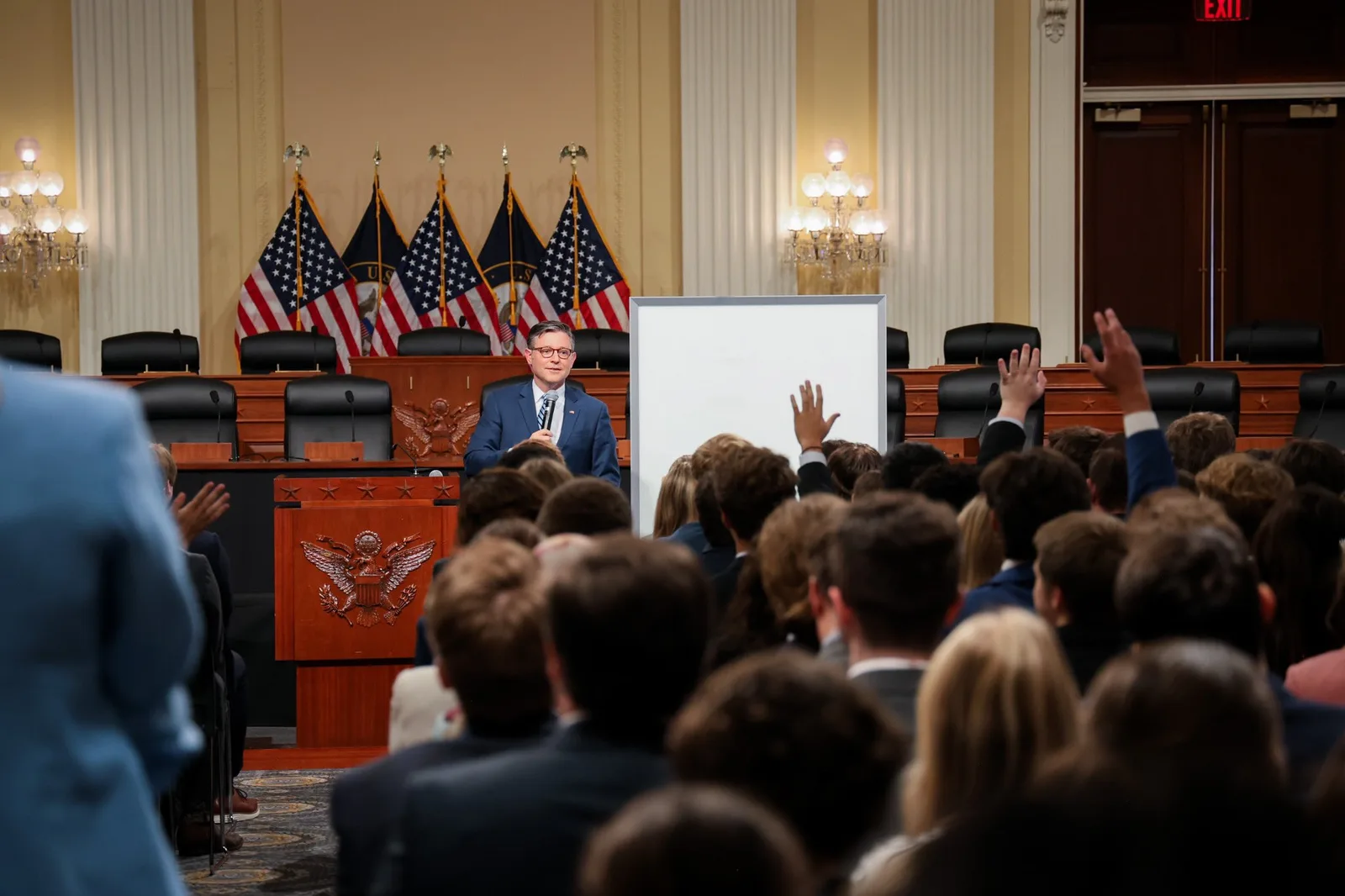 File photo
What happened
Key facts
- House Speaker Mike Johnson said Republicans do not pay attention to polls and argued that polling organizations are reaching fewer Republican voters (per thecentersquare.com, Washington Examiner).
- At a rally in McAllen, Texas, Johnson said polling companies were oversampling Democrats and underestimating Republicans (per thecentersquare.com, Washington Examiner).
- Johnson said low Republican participation affects polling across the board, including the GOP's own polling, and that Republican voters distrust polling calls (per Washington Examiner, thecentersquare.com).
- Johnson accused Democrats of using polls to create a “self-fulfilling prophecy” that could dampen GOP turnout (per Washington Examiner, thecentersquare.com).
- Johnson said 22 races would determine which party wins the U.S. House majority (per thecentersquare.com, Washington Examiner).
- Johnson said he would campaign for Republicans in 40 districts across 22 states that month (per thecentersquare.com).
- The Pew Research Center said Republicans had become slightly less likely than Democrats to participate in polls, particularly in presidential elections, and noted that the issue appeared less pronounced in midterm cycles (per Washington Examiner, thecentersquare.com).
The brief
House Speaker Mike Johnson urged Republicans to disregard polling, saying that Republican voters’ reluctance to participate is making surveys less representative of the electorate. He also said the party does not pay attention to polls and argued that pollsters are reaching Democrats more readily than Republicans.
Johnson made the case at a rally in McAllen, Texas, and in an interview with the Washington Examiner after a campaign stop in New Bern, North Carolina. In McAllen, he said polling companies were oversampling Democrats and underestimating Republicans.
In the Examiner interview, he described low Republican participation as a problem affecting polling broadly, including surveys conducted for the GOP, and said polling organizations acknowledge it. Johnson also accused Democrats of using polls to produce a “self-fulfilling prophecy” that could suppress Republican turnout.
That is Johnson’s characterization of Democrats’ use of polling; the reported coverage does not independently establish that Democrats are using surveys with that purpose. His stated position is that polling should not guide the party’s expectations or campaign choices.
The Washington Examiner cited the Pew Research Center’s discussion of evidence that Republicans have become somewhat less likely than Democrats to take part in polls. The cited research says that pattern may have contributed to polls underestimating Donald Trump and other Republican candidates in the 2016, 2020 and 2024 elections.
It also cautions that participation differences appear less pronounced in midterm elections, while noting that some 2022 polls still underestimated Republican candidates’ support. That context supports a concern about polling participation, but it does not establish that current polls are systematically wrong.
Johnson said 22 races would decide which party holds the House majority. He also said he planned to campaign for Republicans in 40 districts across 22 states that month. Those remarks frame his poll criticism alongside an active campaign effort, rather than as a claim that the House contest is already settled.
The Center Square reported that the Cook Political Report had identified more than 30 races it said had shifted toward Democrats. Johnson’s estimate of 22 decisive races and that report’s count of more than 30 shifted races describe different assessments; they are not competing totals for the same measure.
The coverage also included Johnson’s prediction at the McAllen rally that Republicans would win Congress. The immediate political question raised by Johnson’s remarks is whether Republican voters’ polling participation and the polling models built from responses accurately reflect support in the House contests.
The reported accounts document Johnson’s argument, the Pew findings cited by the Examiner, and the campaign activity he described; they do not establish how the election will turn out or whether low Republican response rates explain the current polling picture.
Why it matters
- Republican voters who do not respond to polling calls may be underrepresented in surveys, the mechanism Johnson says makes polling unreliable; the Pew research cited by the Washington Examiner describes a participation gap but says it is less pronounced in midterms.
- The stakes Johnson identifies are control of the U.S. House: he said 22 races would decide the majority.
- Republican candidates in the 40 districts across 22 states where Johnson said he would campaign could be affected by how the party interprets polling and allocates campaign attention.
- The Cook Political Report’s assessment that more than 30 races had shifted toward Democrats offers a separate indicator of the contest’s competitiveness, while not measuring the same thing as Johnson’s 22-race estimate.
What to watch next
- Whether Johnson campaigns in the 40 districts across 22 states he said he would visit that month.
- How Republican participation in polling compares with Democratic participation, the issue Johnson and the Pew Research Center discussion highlighted.
- Whether polling assessments and campaign attention focus on the 22 races Johnson identified as decisive for House control.
- Whether the Cook Political Report continues to identify races as shifting toward Democrats, beyond the more than 30 cited by The Center Square.
How it's being covered
Coverage analysisShow details5 source articles · 5 unique outlets · 4 distinct reportsCoverage mix: Mixed· 1 Left · 1 Center · 2 RightWhere the outlets are based: US/Canada 60% · Unknown 40%
How outlets' accounts compare
3 framing differences · 2 uncorroborated claims · 2 information gaps- The Center Square foregrounds Johnson’s rally remarks, his planned campaign schedule, and his claim that Republicans would win Congress.
- The Washington Examiner focuses on Johnson’s explanation that low Republican participation, including in GOP polling, makes polls unreliable and includes Pew Research Center context.
- Johnson attributes polling problems to low Republican participation and says pollsters are oversampling Democrats; the Pew Research Center findings cited by the Washington Examiner describe a participation gap but do not establish Johnson’s claim about Democrats’ intent.
- Johnson said the party does not pay attention to polls and accused Democrats of creating a “self-fulfilling prophecy” that could dampen GOP turnout.
- Johnson predicted at the McAllen rally that Republicans would win Congress.
- The sources do not provide polling response-rate figures, survey names, or current poll results with which to assess Johnson’s claims.
- Johnson’s allegation that Democrats use polling to dampen Republican turnout is presented as his claim, not independently established.
How we got here
On September 16, 2024, the Pew Research Center reported that Republicans had become slightly less likely than Democrats to take part in polls; it said the participation gap appeared less consequential in midterm elections, although some 2022 polls underestimated Republican candidates’ support.
That finding followed polling errors in the 2016 and 2020 presidential elections: the American Association for Public Opinion Research’s 2021 review found that polls in both years understated support for Donald Trump.
Original sources
2 of 5 articles · Unknown · Show allEvery story links to the reporting it was built from. How we choose sources
Spotted a factual error, a broken link or a misleading summary? Tell us.