
Rajnath Singh will represent India at SCO meeting in Dushanbe
Defence Minister Rajnath Singh will represent India at the Shanghai Cooperation Organisation’s Council of Heads of Government meeting in Dushanbe, Tajikistan. The meeting is scheduled for October 19 and 20, and Prime Minister Narendra Modi is expected to participate virtually, according to Swarajya.
AI-assisted synthesis · Based on 5 outlets' reporting · Article text read from 2 of 5 outletsHow it's made
View timeline · 8 entries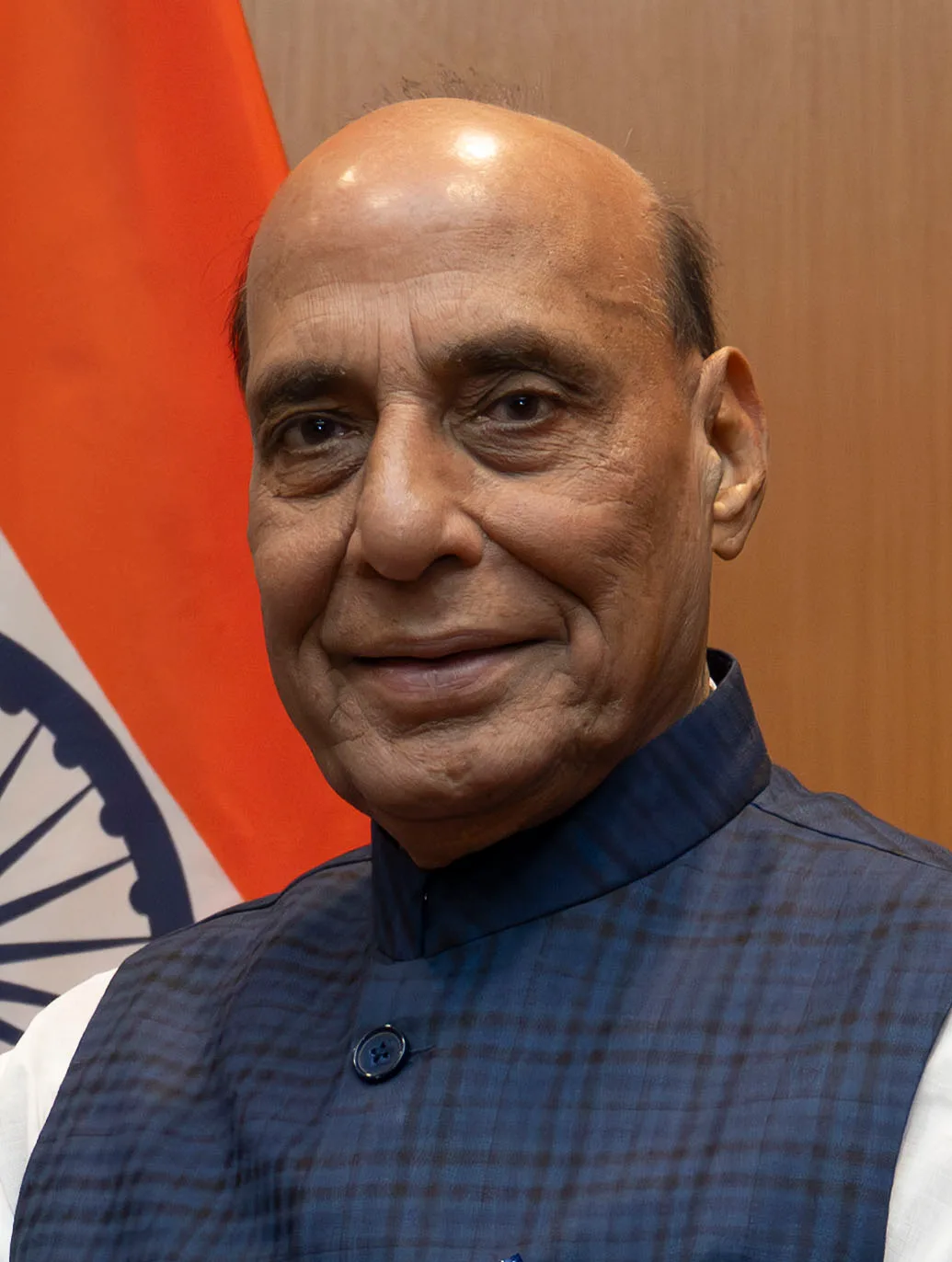 File photo
What happened
Key facts
- Defence Minister Rajnath Singh will represent India at the Shanghai Cooperation Organisation’s Council of Heads of Government meeting in Tajikistan (per swarajyamag.com, The Times of India, newsonair.gov.in).
- The meeting is scheduled to take place in Dushanbe, Tajikistan, on October 19 and 20 (per swarajyamag.com, The Times of India).
- Prime Minister Narendra Modi is expected to participate virtually in the meeting (per swarajyamag.com).
- The meeting is being held under Tajikistan’s 2026 chairmanship of the Shanghai Cooperation Organisation (per swarajyamag.com).
- The meeting is expected to address cooperation among member states, including trade, investment, connectivity, innovation and cultural exchanges (per swarajyamag.com, The Times of India).
- Participating countries are expected to review cooperation initiatives and consider decisions about the organisation’s financial and institutional functioning (per The Times of India).
- India has called for simpler customs procedures, paperless trade, electronic document exchange and stronger multimodal connectivity (per The Times of India).
- Rajnath Singh is scheduled to hold bilateral discussions with Tajik officials about India-Tajikistan relations and further cooperation (per swarajyamag.com, The Times of India, newsonair.gov.in).
The brief
Defence Minister Rajnath Singh will represent India at the Shanghai Cooperation Organisation’s Council of Heads of Government meeting in Dushanbe, Tajikistan, scheduled for October 19 and 20. The Times of India also identifies it as the 25th meeting of the council. News On AIR, India Sentinels and NewsBytes likewise report that Singh will represent India at the gathering.
Prime Minister Narendra Modi is expected to join the two-day meeting virtually, Swarajya reported. The gathering is taking place under Tajikistan’s 2026 chairmanship of the SCO. Singh is also scheduled to hold bilateral discussions with Tajik officials concerning relations between India and Tajikistan and further cooperation, according to Swarajya.
The outlets describe the meeting as a forum for cooperation among member states, with emphasis on economic and practical areas. Swarajya lists trade, investment, transport and logistics, industrial cooperation, digital and creative economy, innovation and financial interaction, as well as social, cultural and humanitarian cooperation.
The Times of India highlights trade, the economy, investment, connectivity, innovation and cultural-humanitarian exchanges. These accounts offer different levels of detail, rather than conflicting descriptions of the agenda.
The Times of India reports that participants are expected to review existing cooperation initiatives and consider decisions concerning the organisation’s financial and institutional functioning. It also says India has called for simpler customs procedures, paperless trade, electronic exchange of documents and stronger multimodal connectivity.
Those proposals place trade processes and transport links among the practical issues India is advancing at the meeting. The Times of India attributes its account of the meeting’s expected focus to ANI, citing the Ministry of Defence.
It also reports that the ministry described India as engaged in SCO mechanisms and referred to Indian initiatives involving start-ups and innovation, digital public infrastructure and people-to-people exchanges. These are the ministry’s stated account of India’s participation and contribution, rather than independently assessed outcomes of the meeting.
The meeting’s immediate purpose, as described by the outlets, is to discuss cooperation and review ongoing initiatives among SCO members. Swarajya says Singh’s visit will include bilateral talks with Tajik officials. It places the visit in the context of India-Tajikistan relations, while the Times of India emphasizes India’s proposals on trade procedures and connectivity.
Neither outlet reports that the scheduled discussions have already produced decisions. Swarajya says India and Tajikistan are competing for a non-permanent United Nations Security Council seat for 2028-29, with elections scheduled for June 2027.
It also notes that India’s External Affairs Minister has generally represented the country at the Council of Heads of Government, while the Prime Minister typically attends the SCO Council of Heads of State summit.
That context makes Singh’s representation notable in the outlet’s account, but the sources do not state that the seat contest or the usual division of representation caused the choice of delegation.
Why it matters
- India’s call for simpler customs procedures, paperless trade and electronic document exchange identifies concrete administrative changes that could shape trade among SCO member states.
- India’s emphasis on multimodal connectivity puts transport links and cross-border movement among the practical cooperation issues on the meeting agenda.
- Swarajya reports that India and Tajikistan are competing for a non-permanent UN Security Council seat for 2028-29; the stated mechanism is an election scheduled for June 2027.
What to watch next
- Whether Rajnath Singh holds the scheduled bilateral discussions with Tajik officials in Dushanbe.
- Whether the participating countries review cooperation initiatives and consider decisions on the SCO’s financial and institutional functioning.
- Whether the meeting addresses India’s proposals for simpler customs procedures, paperless trade, electronic document exchange and multimodal connectivity.
- Whether the India-Tajikistan contest for a 2028-29 non-permanent UN Security Council seat advances toward the election scheduled for June 2027.
How it's being covered
Coverage analysisShow details5 source articles · 5 unique outletsOutlet political mix: Mostly Center· 2 Center · 1 Right · 2 unratedWhere the outlets are based: Asia 40% · Unknown 40% · Other 20%
One source is from a wire service (AP, Reuters, AFP or Bloomberg), whose reporting other outlets often republish.
How outlets' accounts compare
3 framing differences · 1 uncorroborated claim · 1 information gap- Swarajya gives a broader agenda, including transport and logistics, industrial cooperation, digital and creative economy, financial interaction, and social cooperation; The Times of India foregrounds trade, economic issues, connectivity and cultural-humanitarian exchanges.
- The Times of India reports India’s specific customs, paperless-trade and connectivity proposals and expected institutional decisions; Swarajya instead emphasizes Singh’s bilateral talks and the India-Tajikistan seat contest.
- The Times of India attributes details about the meeting’s focus to ANI, citing the Ministry of Defence; Swarajya reports the agenda and bilateral plans directly in its own account.
- The Times of India says India has called for simpler customs procedures, paperless trade, electronic document exchange and stronger multimodal connectivity.
- The sources do not report decisions or outcomes from the meeting, which is scheduled for October 19 and 20.
Timeline
Developments from this story's sources, dated background we compiled and fact-checked, and our earlier coverage. Each row says which.- China, Russia, Kazakhstan, Kyrgyzstan and Tajikistan signed a border confidence-building agreement known as the Shanghai Five.Background · compiled and fact-checked by Updat3
- The Shanghai Five signed an agreement on reducing military forces in border regions.Background · compiled and fact-checked by Updat3
- Uzbekistan joined the grouping in 2001, when the five countries formalised the SCO.Background · from our historical context
- The SCO was founded in Shanghai on June 15, 2001, by China, Russia, Kazakhstan, Kyrgyzstan, Tajikistan and Uzbekistan.Background · from our historical context
- SCO member states signed the organisation’s Charter.Background · compiled and fact-checked by Updat3
- The SCO Charter came into force, setting out the Council of Heads of Government’s role in economic cooperation and budget approval.Background · compiled and fact-checked by Updat3
- India became a full member on June 9, 2017, at the SCO summit in Astana, alongside Pakistan.Background · from our historical context
- External Affairs Minister S. Jaishankar represented India at the SCO Council of Heads of Government meeting in Islamabad and called for stronger connectivity and trade cooperation.Background · compiled and fact-checked by Updat3
How we got here
At the 2025 meeting of the Shanghai Cooperation Organisation’s Council of Heads of Government in Moscow, member states reviewed cooperation and adopted decisions on economic and organisational matters; India was represented by External Affairs Minister S. Jaishankar. The meeting was part of the council’s annual work on practical cooperation, distinct from the SCO Council of Heads of State, which sets the organisation’s broader priorities. The SCO’s institutional framework rests on its Charter, signed on June 7, 2002, and in force from September 19, 2003. The Charter established the Council of Heads of Government as a forum for coordinating economic cooperation and approving the organisation’s budget. The Council of Heads of State remains the SCO’s supreme decision-making body. The organisation’s work also draws on the 2001 Shanghai Convention on Combating Terrorism, Separatism and Extremism, which set out cooperation against what the members termed the “three evils.”
The SCO was founded in Shanghai on June 15, 2001, by China, Russia, Kazakhstan, Kyrgyzstan, Tajikistan and Uzbekistan. Its roots lie in the “Shanghai Five”: China, Russia and three Central Asian states that signed an agreement on confidence-building measures along their borders on April 26, 1996, followed by an agreement on reductions of military forces in border regions on April 24, 1997. Uzbekistan joined the grouping in 2001, when the five countries formalised the SCO. India became a full member on June 9, 2017, at the SCO summit in Astana, alongside Pakistan. India had held observer status since 2005, and the 2015 summit in Ufa began the process for both countries’ accession. India’s participation has since combined security cooperation with economic priorities: at the 2024 heads-of-government meeting in Islamabad, Jaishankar represented India and called for better connectivity and trade cooperation, while also stressing the need to respect sovereignty and territorial integrity.
Original sources
1 of 5 articles · US/Canada · Show allEvery story links to the reporting it was built from. How we choose sources
Spotted a factual error, a broken link or a misleading summary? Tell us.