
Social Security trust fund could run dry in 2032, cutting benefits
The Social Security trust fund is projected to run dry in 2032, and benefits could shrink if Congress does not change the law. A separate report puts the 2027 cost-of-living adjustment at 3.6 percent, or about $75 a month on average.
AI-assisted synthesis · Based on 4 outlets' reporting · Article text read from 2 of 4 outletsHow it's made
View timeline · 8 entries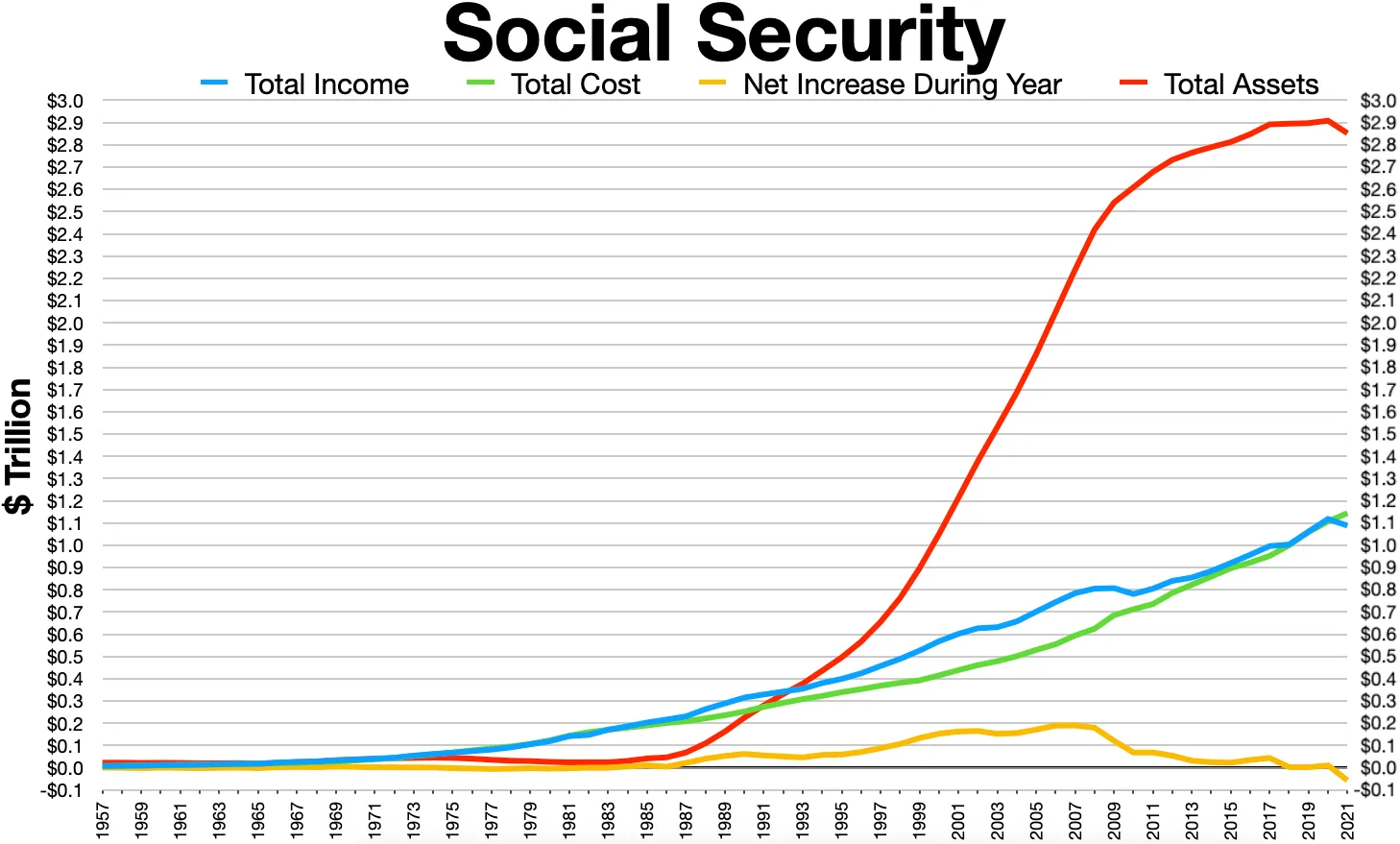 File photo
What happened
Key facts
- The Social Security trust fund is projected to run dry in 2032 (per Washington Examiner).
- Social Security benefits are projected to shrink beginning in 2032 unless Congress changes the law (per Washington Examiner).
- The average Social Security check is about $2,100 a month before the 2027 increase, according to Jacobs (per urbanmilwaukee.com).
- Social Security ran an annual surplus from 1983 through 2010, and its trust fund reserves reached $2.6 trillion in 2010 (per Washington Examiner).
The brief
The Social Security trust fund is projected to run dry in 2032, and benefits could shrink from that point unless Congress changes the law, according to the Washington Examiner. The projection puts the program’s ability to pay scheduled benefits at the center of a looming policy decision: lawmakers could alter taxes, change the benefit formula or increase federal borrowing.
The potential reduction is not presented in the reporting as an enacted cut. The Washington Examiner describes lower benefits as the outcome if the law remains unchanged. Separately, Jacobs said beneficiaries could face cuts of at least 20 percent if no changes are made. That estimate is a claim attributed to Jacobs, rather than a separate projection detailed in the report.
A different, nearer-term issue is the annual cost-of-living adjustment. Urban Milwaukee reported that the 2027 adjustment is 3.6 percent, amounting to roughly $75 per month on average. Jacobs put the average monthly Social Security check before that increase at about $2,100.
Those figures describe the scheduled adjustment and current average payment; they do not establish that the 2032 trust-fund projection has changed. Urban Milwaukee also cited September Consumer Price Index data showing prices 3.7 percent higher than a year earlier.
The comparison gives context for the purchasing-power question raised in the report, but the excerpt does not establish that the adjustment and inflation measure cover identical costs or periods. The article also quotes Christianson saying the adjustment does not ensure financial security and that people are facing difficult choices.
The policy choices identified by the Washington Examiner are changes to taxes, the benefit formula or federal borrowing. The reporting does not describe a decision by Congress on any of those options. As a result, the 2032 date is a projection under current law, while the means of addressing the projected shortfall remain matters for lawmakers.
The Washington Examiner places the current forecast in a longer financial context: Social Security recorded annual surpluses from 1983 through 2010, and reserves stood at $2.6 trillion in 2010. Its account says the surplus is what is running out in 2032.
That framing distinguishes the depletion of reserves from the disappearance of the program itself; the stated consequence under unchanged law is reduced benefits.
Why it matters
- Social Security beneficiaries face the prospect of lower scheduled payments beginning in 2032 if Congress leaves the law unchanged.
- The size of the potential shortfall matters to recipients: Jacobs said cuts could reach at least 20 percent, while the average check before the 2027 adjustment is about $2,100 a month.
- For recipients, the 2027 adjustment is reported as roughly $75 per month on average; the cited September CPI increase was 3.7 percent year over year.
What to watch next
- Whether Congress changes Social Security law before the trust fund is projected to run dry in 2032.
- Whether lawmakers pursue changes to taxes, the benefit formula or federal borrowing, the options identified by the Washington Examiner.
- How the 2027 cost-of-living adjustment of 3.6 percent compares with subsequent inflation data.
How it's being covered
Coverage analysisShow details4 source articles · 4 unique outletsOutlet political mix: Mostly Center· 2 Center · 1 Right · 1 unratedWhere the outlets are based: US/Canada 50% · Unknown 50%
How outlets' accounts compare
1 framing difference · 2 uncorroborated claims · 4 information gaps- The Washington Examiner centers the projected 2032 trust-fund depletion and the possibility of benefit reductions under unchanged law; Urban Milwaukee focuses on the 2027 cost-of-living adjustment, average checks and purchasing power.
- Jacobs said beneficiaries could see cuts of at least 20 percent if no changes are made.
- Christianson said the cost-of-living adjustment does not amount to financial security and described people as facing difficult choices.
- The sources do not specify the projected trust-fund depletion calculation or the assumptions behind it.
- The sources do not identify a proposed legislative text, congressional vote or enacted measure addressing the 2032 projection.
- The sources do not give a detailed account of how the reported 2027 adjustment was calculated.
- Jacobs's estimate that cuts could reach at least 20 percent is not accompanied by a calculation or further explanation in the report.
Timeline
Developments from this story's sources, dated background we compiled and fact-checked, and our earlier coverage. Each row says which.- The program’s basic structure dates to the Social Security Act, signed by President Franklin D. Roosevelt on August 14, 1935.Background · from our historical context
- Congress amended the Social Security Act, expanding benefits and changing how they were calculated.Background · compiled and fact-checked by Updat3
- Congress amended the Social Security Act to establish automatic annual cost-of-living adjustments.Background · compiled and fact-checked by Updat3
- Congress amended Social Security’s benefit formula and payroll-tax schedule.Background · compiled and fact-checked by Updat3
- The National Commission on Social Security Reform issued a report recommending changes to Social Security financing.Background · compiled and fact-checked by Updat3
- The Social Security Amendments of 1983, signed by President Ronald Reagan on April 20, 1983, changed those rules after a financing crisis.Background · from our historical context
- Social Security trust fund reserves reached $2.6 trillion.Background · compiled and fact-checked by Updat3
- A 2.8% cost-of-living adjustment took effect for Social Security benefits.Background · compiled and fact-checked by Updat3
How we got here
The Social Security trustees’ 2024 annual report projected that the retirement and survivors insurance trust fund would be depleted in 2033; it projected that the combined retirement and disability funds would be depleted in 2035. The Social Security Amendments of 1983, signed by President Ronald Reagan on April 20, 1983, changed those rules after a financing crisis.
Social Security then recorded an annual surplus from 1983 through 2010, and reserves reached $2.6 trillion in 2010. The 1983 changes followed recommendations from the National Commission on Social Security Reform, chaired by Alan Greenspan.
Original sources
4 articles from 4 outletsEvery story links to the reporting it was built from. How we choose sources
Spotted a factual error, a broken link or a misleading summary? Tell us.