
SpaceX Falcon 9 launch produced bright 'jellyfish cloud' visible across US east coast
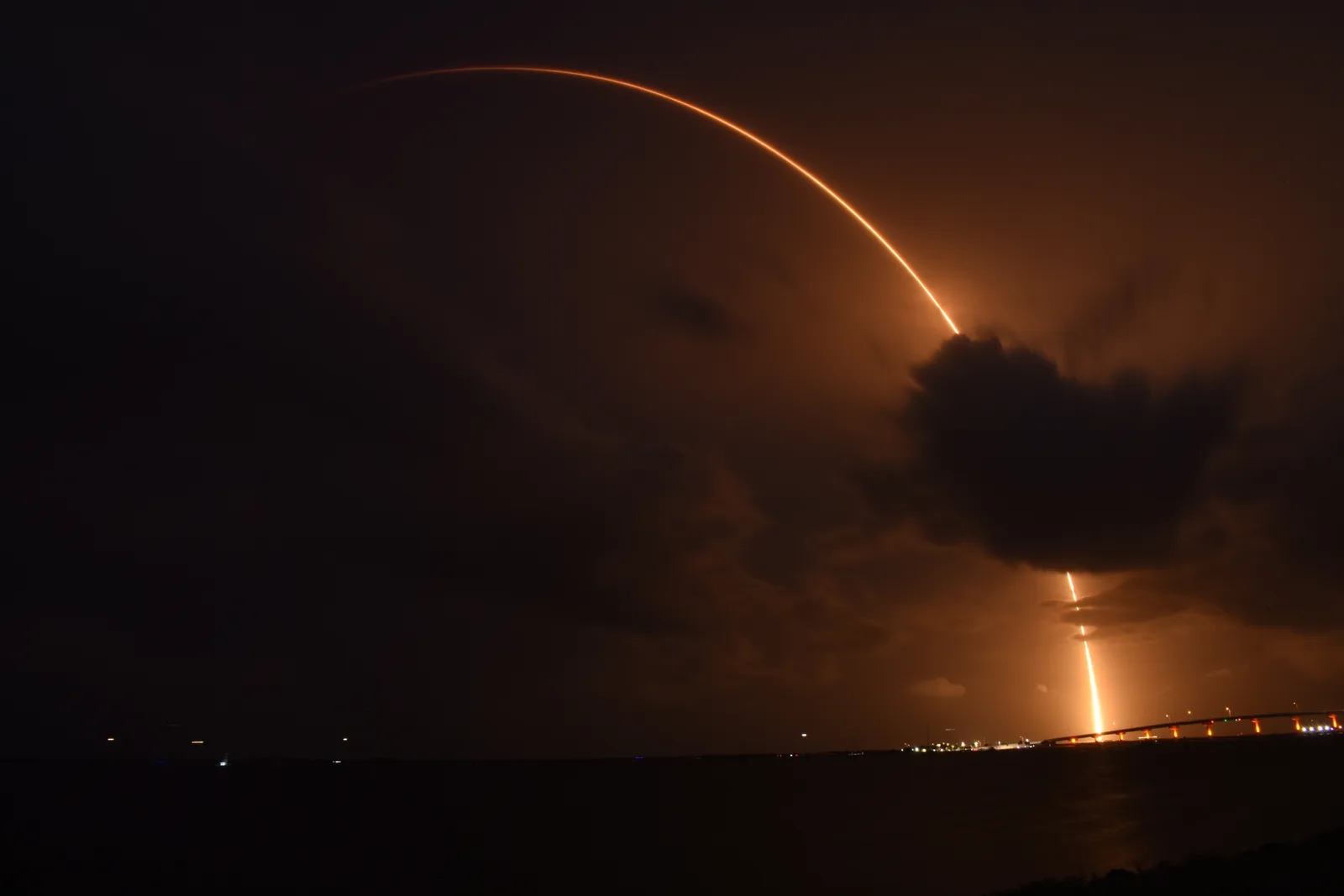
SpaceX launched a Falcon 9 rocket early on Oct. 13 that produced a luminous plume people described as a 'jellyfish cloud' visible across parts of the eastern United States. The plume formed shortly after liftoff and was photographed by viewers from Florida to Missouri as the Dragon spacecraft headed to the International Space Station.
AI-assisted synthesis · Based on 5 outlets' reporting · Full text read from 4 of 5 outletsHow it's made
 File photo
What happened
Key facts
- A giant "jellyfish cloud" may have appeared in the sky over the US after the launch of a Falcon 9 rocket
The brief
SpaceX launched a Falcon 9 rocket early on Oct. 13, and the rocket's exhaust plume created a widely seen luminous 'jellyfish cloud' across parts of the eastern United States. Local stations and national space outlets reported that the CRS-35 Dragon spacecraft lifted off from Cape Canaveral Space Force Station in the pre-dawn hours and that shortly after liftoff a bright plume formed and spread, prompting viewers from Florida through states like Missouri and Tennessee to photograph and share the display. Space outlets and NASA's Kennedy Space Center noted the visual was widely discussed online as a 'space jellyfish.'
Local coverage said clear skies and calm conditions allowed the rocket's hot exhaust to freeze into ice crystals in the upper atmosphere, producing the glowing, jellyfish-like appearance; that explanation appears in regional reports and was used by television stations that published viewer photos. Sources give slightly different times for the sighting window: local outlets reported liftoff around 5:30 a.m. Eastern Time while other local reports referenced about 6:33 a.m., but all place the event in the early morning of Oct. 13. Photographers captured the phenomenon from points as far inland as Malden, Missouri and from cities across Florida and Georgia, showing the plume's visibility over a wide area. SpaceX's CRS-35 mission is a commercial resupply flight carrying cargo for the International Space Station, and outlets say the Dragon capsule is scheduled for an approximately 52-hour trip to dock with the station. Local reporters and social-media posts framed the spectacle as both a routine mission milestone and a rare atmospheric show accessible to many viewers because of favorable weather and lighting. One outlet noted another Falcon 9 launch from Cape Canaveral was scheduled for Oct. 19, giving the public another chance to see a similar display. The coverage combines space- and community-focused reporting: national space publications framed the plume as part of CRS-35's ascent and arrival timeline, while local stations highlighted eyewitness images and the atmospheric explanation. No source in this pack reports injuries, damage, or any safety incident connected to the launch or the plume; the reporting centers on visual sightings, timing of the mission, and the Dragon spacecraft's planned docking at the International Space Station.
Why it matters
- Residents along the eastern U.S. seaboard and inland viewers in states such as Missouri directly experienced the visual phenomenon and submitted photographs to local media, showing how routine orbital launches can produce widely visible atmospheric effects that capture public attention.
- The mechanism producing the display—rocket exhaust plumes freezing into ice crystals in clear, calm upper-atmosphere conditions—is documented in local and space reporting and explains why the spectacle was visible over a broad area during the early-morning launch window.
- CRS-35's 52-hour cargo flight to the International Space Station connects the visual event to operational spaceflight activity, making the spectacle a byproduct of a scheduled resupply mission rather than an anomalous test or failure.
- The scheduled follow-up Falcon 9 launch from the same Cape Canaveral facility on Oct. 19 provides another concrete opportunity for residents and researchers to observe similar plume formation under comparable atmospheric conditions.
What to watch next
- Whether SpaceX conducts the reported follow-up Falcon 9 launch from Cape Canaveral on Oct. 19 as scheduled.
- Whether the CRS-35 Dragon docks to the International Space Station after the approximately 52-hour flight around Oct. 15.
- Whether local meteorological conditions (clear skies and calm upper-atmosphere winds) repeat and produce another widely visible plume during the Oct. 19 launch window.
How it's being covered
Coverage analysisShow details6 source articles · 5 unique outletsCoverage mix: Mostly Center· 1 Left · 2 CenterWhere the outlets are based: Europe 40% · Unknown 40% · Other 20%
How outlets' accounts compare
1 factual disagreement · 3 framing differences · 1 uncorroborated claim · 3 information gaps- Sources give slightly different reported liftoff times and sighting times on Oct. 13, with some local reports citing about 5:30 a.m. Eastern and others citing about 6:33 a.m.
- Local TV outlets emphasize eyewitness photos and community reaction, while national space outlets place the event in the context of the CRS-35 mission timeline and NASA/SpaceX posts.
- Some outlets describe the phenomenon as a public spectacle ('jellyfish cloud' or 'space jellyfish'); space-focused reporting frames it as a predictable atmospheric effect tied to rocket exhaust and mission timing.
- All sources attribute the launch to SpaceX and the mission to CRS-35; local outlets attribute photographs and eyewitness accounts to viewers in specific towns.
- NASA's Kennedy Space Center wrote on X that 'Many of you are talking about the "space jellyfish" following this morning's launch...' (reported in space-focused coverage).
- No report Updat3 read provides technical atmospheric measurements (altitude, temperature, humidity, or wind profiles) that would quantify exactly where and how the plume froze into ice crystals.
- No source supplies independent scientific analysis or statements from an atmospheric scientist beyond local outlets' explanatory descriptions.
- No source reports any instrumented observations from aircraft or satellites that would map the plume's dispersion in detail.
How we got here
SpaceX was founded by Elon Musk in 2002 and developed the Falcon 9 rocket family with its maiden flight on June 4, 2010. The Falcon 9 achieved routine reflight capability after the first successful orbital-class booster landing on December 21, 2015, which enabled the high cadence of launches from U.S. sites.
U.S. commercial launches operate under the regulatory framework of the Commercial Space Launch Act (1984) and the Commercial Space Launch Amendments Act of 2004, administered by the FAA Office of Commercial Space Transportation.
Original sources
3 of 6 articles · Unknown · Show allEvery story links to the reporting it was built from. How we choose sources
Spotted a factual error, a broken link or a misleading summary? Tell us.