
Ueda says BOJ cannot accept underlying inflation rising above 2%
Bank of Japan Governor Kazuo Ueda said underlying inflation was already roughly 2% and that the central bank could not tolerate it rising further. He said the policy focus had shifted to keeping inflation around the target, while the BOJ’s September rate increase was its second in three months.
AI-assisted synthesis · Based on 4 independent reports from 5 outlets · Article text read from 2 of 4 reportsHow it's made
View timeline · 8 entries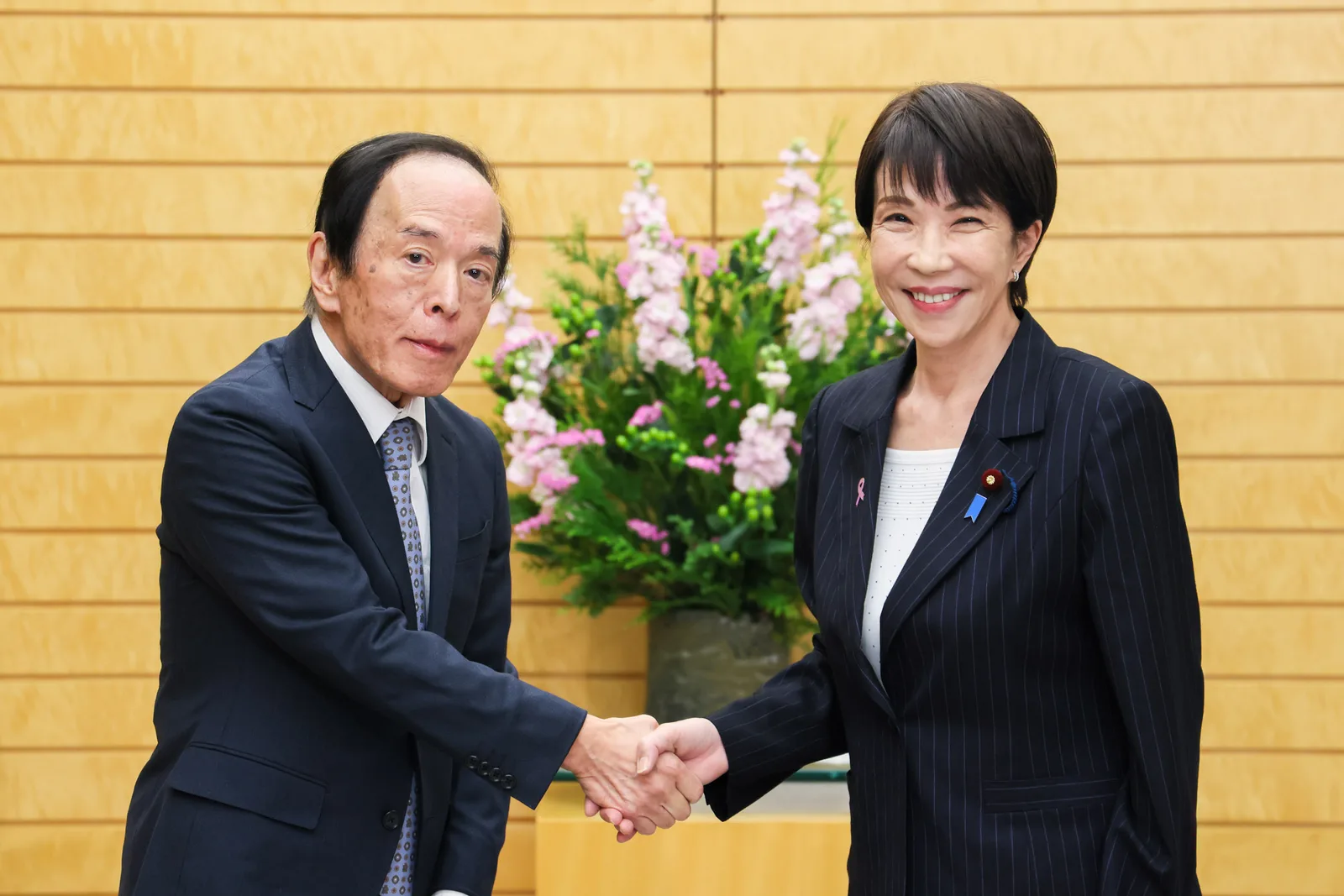 File photo
What happened
Key facts
- Bank of Japan Governor Kazuo Ueda said the BOJ could not tolerate underlying inflation rising further above 2% (per businesstimes.com.sg, The Japan Times).
- Ueda said underlying inflation was already roughly around 2% (per businesstimes.com.sg, The Japan Times).
- Ueda said the policy phase had shifted toward ensuring inflation settles around 2% as a key objective (per businesstimes.com.sg).
- Ueda made the comments on Friday, October 16, when asked whether prices nearing the BOJ’s target would affect policy management (per businesstimes.com.sg).
- Underlying inflation was projected to reach a level consistent with the BOJ’s 2% target sometime in the next 18 months (per businesstimes.com.sg).
- Japan’s September inflation report was expected to show overall prices rising 2.1% year over year, prices excluding fresh food rising 2.1%, and prices excluding fresh food and energy rising 2.3% (per The Japan Times).
The brief
Bank of Japan Governor Kazuo Ueda said the central bank could not accept underlying inflation rising further above 2%, describing the current level as already roughly around that threshold. His comments put maintaining inflation near the BOJ’s target at the center of its policy discussion.
Ueda made the remarks on Friday while answering a question about whether prices approaching the target would affect policy management. He said the policy phase had shifted toward ensuring inflation settles around 2% as a key objective.
The emphasis in his statement was on limiting further movement above the target, rather than treating the approach to 2% as a reason by itself to change course. The Business Times reported that the BOJ raised rates in September for the second time in three months, calling the pace the fastest monetary tightening since 1990.
That account also said price developments had broadly matched the bank’s projections and that underlying inflation was expected to reach a level consistent with the target within the next 18 months. The Japan Times likewise noted the September rate increase, but emphasized Ueda’s comments as reinforcing expectations of additional increases in coming months.
The Wall Street Journal and Bloomberg headlines also centered on Ueda’s warning about inflation exceeding 2%; those headlines do not establish further details about the bank’s policy path. A separate near-term data point was Japan’s September inflation report.
The Japan Times said it was expected to show overall prices up 2.1% from a year earlier, with the measure excluding fresh food also at 2.1% and the measure excluding fresh food and energy at 2.3%. Those figures were forecasts in the report, not published results.
The distinction matters because Ueda’s comments concerned underlying inflation, while the cited figures refer to several separate price measures. The accounts do not describe a new rate decision accompanying Ueda’s remarks.
The Japan Times reported that investors and economists expected no change at the bank’s next policy decision, while also portraying the comments as supporting expectations of future increases. Those are expectations about different horizons, not an announcement by the BOJ: Ueda’s quoted remarks set out the inflation objective but did not specify a rate decision or timetable.
The central bank’s stated challenge, as described by Ueda, is to keep underlying inflation from moving further above 2% while steering it toward settling around that level. The September increase and the reported projections provide the policy context; the upcoming inflation figures would offer another measure against which to assess price trends.
The cited coverage does not report a new decision beyond the September rate move or a specific schedule for further changes.
Why it matters
- Japanese households face the direct purchasing-power stakes of price growth: the September report was forecast to show overall inflation of 2.1%, with the measure excluding fresh food and energy at 2.3%.
- The BOJ’s policy trade-off is concrete: Ueda said underlying inflation was roughly 2% and that the bank could not tolerate it rising further, while the bank had already raised rates twice in three months.
- The September increase was described by The Business Times as the fastest monetary tightening since 1990, making the pace of policy adjustment a central part of how the BOJ’s inflation objective is understood.
What to watch next
- Whether Japan’s September inflation report matches the forecasts of 2.1% for overall prices, 2.1% excluding fresh food, and 2.3% excluding fresh food and energy.
- Whether the BOJ changes rates at its next policy decision; The Japan Times reported that investors and economists expected no change.
- Whether subsequent BOJ communications continue to emphasize keeping underlying inflation around 2% or provide a timetable for further rate changes.
How it's being covered
Coverage analysisShow details5 source articles · 5 unique outlets · 4 distinct reportsOutlet political mix: Mostly Center· 4 Center · 1 RightWhere the outlets are based: Asia 40% · US/Canada 20% · Other 40%
- Coverage is currently concentrated among Center-rated outlets (4 of 5 rated sources); comparatively few Left-rated outlets have published on the event.
2 sources are from a wire service (AP, Reuters, AFP or Bloomberg), whose reporting other outlets often republish.
How outlets' accounts compare
1 framing difference · 1 uncorroborated claim · 2 information gaps- The Business Times foregrounds Ueda’s stated objective of keeping inflation around 2% and gives the September rate increase’s historical pace; The Japan Times frames his remarks as reinforcing expectations of further rate increases.
- Ueda said he “can’t tolerate” underlying inflation rising further above 2%.
- The sources do not provide household-level effects of the reported inflation figures, such as changes in wages or purchasing power.
- The sources do not establish a specific timetable for future rate increases.
Timeline
Developments from this story's sources, dated background we compiled and fact-checked, and our earlier coverage. Each row says which.- The Bank of Japan cut its short-term interest rate effectively to zero.Background · compiled and fact-checked by Updat3
- The Bank of Japan adopted quantitative easing and used bank reserves as its operating target.Background · compiled and fact-checked by Updat3
- The framework’s central benchmark was established on January 22, 2013, when the BOJ and the Japanese government issued a joint statement setting a 2% inflation target.Background · from our historical context
- In April 2013, under Governor Haruhiko Kuroda, the BOJ launched “quantitative and qualitative monetary easing” to reach that target, including large-scale asset purchases.Background · from our historical context
- Kazuo Ueda took office as governor of the Bank of Japan.Background · compiled and fact-checked by Updat3
- In July 2024, the BOJ raised its policy rate again, to about 0.25%, and announced plans to reduce government-bond purchases, marking a further step in that normalization.Background · from our historical context
- The Bank of Japan raised its policy rate to 0.5%.Background · compiled and fact-checked by Updat3
- Ueda made the comments on Friday, October 16, when asked whether prices nearing the BOJ’s target would affect policy management.
How we got here
In March 2024, the Bank of Japan ended its negative-interest-rate policy and yield-curve control, raising its short-term rate for the first time since 2007 and shifting away from the framework used to support inflation.
In July 2024, the BOJ raised its policy rate again, to about 0.25%, and announced plans to reduce government-bond purchases, marking a further step in that normalization. The framework’s central benchmark was established on January 22, 2013, when the BOJ and the Japanese government issued a joint statement setting a 2% inflation target.
Original sources
1 of 5 articles · Global · Show allEvery story links to the reporting it was built from. How we choose sources
Spotted a factual error, a broken link or a misleading summary? Tell us.